
2024 EDITIONFinTech Index for Small and
FinTech Index for Small and
Medium-Sized Banks, 2024
Released in 2024 and based on 2023 data. The assessment covers 412 banks, 406 of them small and medium-sized, with results grouped into tiers by bank type.
SAMPLE AND DATA
Sample and data
Starting from the People's Bank of China list of incorporated banking institutions, the group supplemented database holdings with annual reports from bank websites, China Money and other sources, assembling usable annual reports for 541 banks over 2015–2023, 535 of them small and medium-sized. Each bank in this collection has at least three years of available data in the period.
The index released in 2024 uses 2023 data and assesses 412 banks, 406 of them small and medium-sized. The figure of 541 describes the multi-year collection; 412 is the 2023 assessment sample.
Data sources
- Bank list
- People's Bank of China list of incorporated banking institutions, matched with the Wind database
- Annual reports
- Database holdings, supplemented from bank websites, China Money and other sources
- Financial data
- Wind
- Violation data
- RESSET financial research database
- Patents and software copyrights
- Patent records; software copyright registrations from the Copyright Protection Center of China
- Board and senior management
- Annual reports, supplemented by corporate information platforms such as Aiqicha
| Bank type | Sample | SampleLeading tier | Published tier results |
|---|---|---|---|
| Joint-stock commercial banks | 12 | 6 in leading tier | |
| City commercial banks | 99 | 10 in leading tier | |
| Rural commercial banks | 206 | 10 in leading tier | |
| Privately owned banks | 6 | 3 in leading tier | |
| Village and township banks | 49 | 10 in leading tier | |
| State-owned and foreign banks | 40 | Tier results not published | |
| Total | 412 | including 406 small and medium-sized banks | |
TECHNICAL ROUTE
Technical route
Annual-report information is processed as text and combined with violation and intellectual property data to form seven variables; weights are then estimated against existing industry rankings to produce the overall assessment.
- 1
Data collection
- People's Bank of China list of incorporated banking institutions
- Matched with bank lists in the Wind database
- Annual reports gathered by web crawler
- Violation data
- Patent data
- Software copyright data
- 2
Data processing
- Annual reports converted to text (RESSET database)
- Extraction of organisational, board and management, keyword and financial information
- Text analysis: is the information fintech-related?
- Violation data pass through the same fintech-relevance check
- Patent and software copyright data are not text-filtered
- 3
Index construction: seven variables
- Fintech-related keyword frequency
- Fintech-related organisational structure
- Fintech-related board and senior management backgrounds
- Fintech-related violation records
- Invention patents
- Utility model patents
- Software copyrights
- 4
Weighting and assessment
- Existing industry rankings used as the training reference
- Variable weights estimated by classical regression
- Overall assessment of the 2023 sample
- Tiers formed separately for each bank type
- Annual reports
- Violation data
- Intellectual property data
- Model estimation
VARIABLES AND WEIGHTS
Variables and weights
The fintech dictionary
The keyword-frequency variable relies on a fintech dictionary, obtained as the difference between policy texts on fintech and texts unrelated to fintech, then expanded with a topic model.
Two editions of the Fintech Development Plansegmentation → fintech-related vocabulary
Three editions of the Commercial Bank Law of the PRCsegmentation → non-fintech vocabulary
Set difference
Fintech dictionaryused to count keywords in annual reports
Vocabulary categories
Fintech technologies
- Artificial intelligence
- Blockchain
- Cloud technology
- Big data
- Internet of things
- Mobile internet
- Applications
- Regulation and risk control
How the seven variables are formed
| Variable | Information and processing | Interpretation |
|---|---|---|
| Fintech-related keyword frequency | Search annual reports with the fintech dictionary and count occurrences of relevant terms. | Captures attention to and disclosure of fintech in annual reports; read together with the other variables. |
| Fintech-related organisational structure | Locate descriptions of organisational structure and departments, then match terms such as fintech, information technology and data management with labels such as department and centre. | Captures the organisational provision for technology and digital functions. |
| Fintech-related board and senior management backgrounds | Identify education in computing, software and information science, and experience in IT, R&D and digital transformation, from annual reports supplemented by a corporate information platform. | Captures fintech-related expertise among directors, supervisors and senior managers. |
| Fintech-related violation records | Compile violation data and use text analysis to identify records related to fintech. | Adds a governance and risk perspective to information on technology investment and use. |
| Invention patents | Collect invention patent records associated with each bank. | Captures innovation activity observable in patent records. |
| Utility model patents | Collect utility model patent records, separately from invention patents. | Captures innovation activity through a second category of intellectual property. |
| Software copyrights | Compile software copyright registrations associated with each bank. | Captures registered software-related intellectual property. |
Estimating the weights
The release document trains the weights against existing rankings: with existing industry rankings as the reference, classical regression estimates the relationship between each variable and the ranking, and the estimated weights are then applied to the sample banks. The weights come from the model, not from a simple average of the five dimensions.
FRAMEWORK
Five dimensions and the information behind them
The December 2024 forum presentation describes the main information behind each dimension. Annual-report keywords serve three dimensions, and fintech operations draws on three kinds of information, so the five dimensions and seven variables do not correspond one to one, and the variables should not be read as dimension scores.
- 01
Fintech strategy implementation
Focuses on how fintech is positioned in a bank's development strategy and how digital transformation is advanced.
Main information
- Annual-report keywords
- 02
Talent and organisational structure
Examines fintech-related talent, the backgrounds of management and the departments set up for technology.
Main information
- Organisational structure
- Board and senior management
- 03
IT governance and risk
Brings technology governance and related risk information into the assessment, focusing on management requirements in technology use.
Main information
- Violation records
- 04
Fintech operations
Examines the use of fintech in business operations and the building of technical capability.
Main information
- Annual-report keywords
- Patents
- Software copyrights
- 05
Fintech services
Focuses on the use of technology in financial services and its support for a bank's service capability.
Main information
- Annual-report keywords
READING THE RESULTS
How to read the results
- Tiers are formed within each bank type, and banks within a tier are not ranked. The site lists the leading-tier banks named in the release materials, under the names used at the time.
- The indicators capture fintech characteristics observable in public information. This is a research assessment, not a credit rating or an overall ranking of bank performance.
- The weights are estimated from the existing rankings used for training; statistical relationships in the model do not establish causal effects.
- The release materials describe the variables and modelling approach but do not list final coefficients, standardisation or score conversion, so no scores are shown here. Before comparing editions, check that the samples, data years, definitions and models are consistent.
2024 RESULTS
Leading-tier banks
The 39 leading-tier banks listed in the December 2024 forum presentation, grouped by bank type.
Joint-stock commercial banksLeading tier · 12 banks of this type assessed

Shanghai Pudong Development Bank Co., Ltd.

China CITIC Bank Co., Ltd.

Ping An Bank Co., Ltd.

China Merchants Bank Co., Ltd.

China Everbright Bank Co., Ltd.
City commercial banksLeading tier · 99 banks of this type assessed

Bank of Beijing Co., Ltd.

Bank of Hangzhou Co., Ltd.

Bank of Nanjing Co., Ltd.

Bank of Ningbo Co., Ltd.

Xiamen International Bank Co., Ltd.

Bank of Guangzhou Co., Ltd.

Bank of Shanghai Co., Ltd.

Bank of Changsha Co., Ltd.

Zhongyuan Bank Co., Ltd.

Bank of Chongqing Co., Ltd.
Rural commercial banksLeading tier · 206 banks of this type assessed

Beijing Rural Commercial Bank Co., Ltd.

Bozhou Yaodu Rural Commercial Bank Co., Ltd.

Chengdu Rural Commercial Bank Co., Ltd.

Jiangsu Changshu Rural Commercial Bank Co., Ltd.

Jiangsu Jiangyin Rural Commercial Bank Co., Ltd.

Jiangsu Kunshan Rural Commercial Bank Co., Ltd.

Jiangsu Zhangjiagang Rural Commercial Bank Co., Ltd.

Qingdao Rural Commercial Bank Co., Ltd.

Shanghai Rural Commercial Bank Co., Ltd.

Chongqing Rural Commercial Bank Co., Ltd.
Privately owned banksLeading tier · 6 banks of this type assessed

Shenzhen Qianhai WeBank Co., Ltd.

Hunan Sanxiang Bank Co., Ltd.

Zhejiang MYbank Co., Ltd.
Village and township banksLeading tier · 49 banks of this type assessed

Cili Shanghai Rural Commercial Village Bank Co., Ltd.
Shanghai Chongming Shanghai Rural Commercial Village Bank Co., Ltd.
Tai'an Shanghai Rural Commercial Village Bank Co., Ltd.
Rizhao Shanghai Rural Commercial Village Bank Co., Ltd.
Yanggu Shanghai Rural Commercial Village Bank Co., Ltd.
Lianyuan Shanghai Rural Commercial Village Bank Co., Ltd.
Chongqing Qianjiang Yintai Village Bank
Chongqing Qianjiang Yintai Village Bank Co., Ltd.
Linli Shanghai Rural Commercial Village Bank Co., Ltd.

Zhejiang Haiyan Hushang Village Bank Co., Ltd.
Ningyang Shanghai Rural Commercial Village Bank Co., Ltd.
No matching bank. Try another name.
Logos identify each bank and come from bank websites or official apps; where no logo was available, the name is shown.
XIAMEN · 14 DECEMBER 2024
Forum presentation
On 14 December 2024, Jiajing Sun presented the evaluation index system for the fintech competitiveness of small and medium-sized commercial banks on behalf of the group at the China Finance Forum and 15th Journal of Financial Research Forum, held at Xiamen University.
Xiamen University conference report (Chinese) ↗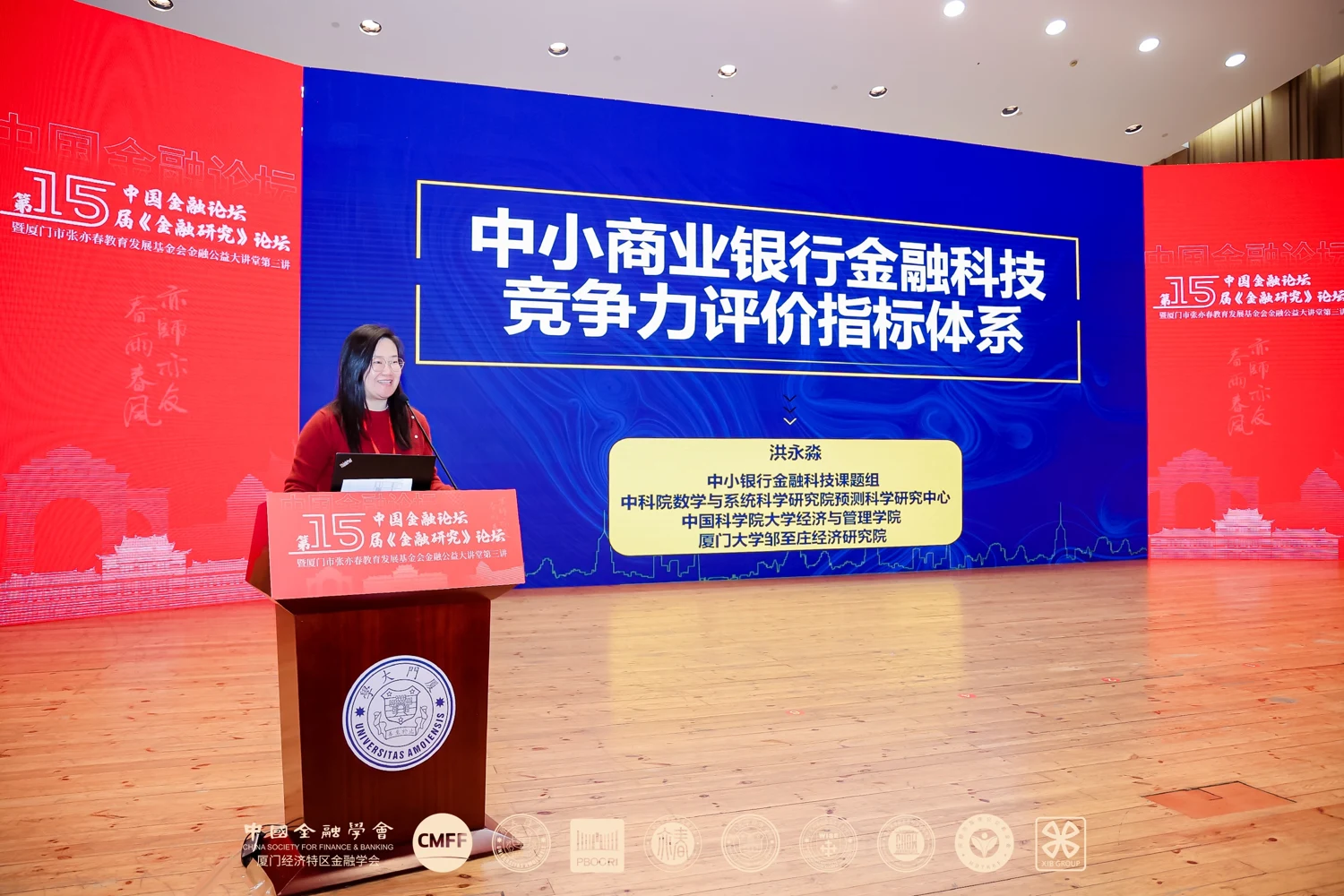
TEAM
Fintech Research Group
The Fintech Research Group works on fintech research and teaching. Its members are Yongmiao Hong, Shouyang Wang, Jiajing Sun, Youwei Yang and Xiaoan Ma.
Member profiles → Yongmiao HongDistinguished Research Fellow, Academy of Mathematics and Systems Science and Center for Forecasting Science, Chinese Academy of Sciences; Distinguished Professor, School of Economics and Management, University of Chinese Academy of Sciences
 Shouyang WangResearch Fellow, Academy of Mathematics and Systems Science, Chinese Academy of Sciences; Director, Center for Forecasting Science, Chinese Academy of Sciences
 Jiajing SunDeputy Director, Department of Statistics and Data Science, School of Economics and Management, University of Chinese Academy of Sciences
 Youwei YangChief Economist, SOLAI Limited; part-time positions at Xiamen University, University of Chinese Academy of Sciences and Sun Yat-sen University
 Xiaoan MaDoctoral student, Chow Institute, Xiamen University
Sources
- Evaluation Index System for the Digital Finance Competitiveness of Small and Medium-Sized Commercial Banks, release document, October 2024, Chapter 3: data collection, text analysis, explanatory variables and modelling (Figures 3 and 6–8).
- Technical report of the same month, Section 2.1: data sources.
- December 2024 forum slides and speech: information behind each dimension, sample sizes by bank type and leading-tier lists.